
The CMO's Growth Driving Playbook
This Growth Driver’s Playbook highlights the five key plays all CMOs need to undertake if they are to drive successful growth. More
How to Shape Marketing-Inspired Business Strategies
A new 2018 initiative by the CMO Council and Deloitte is aimed at empowering both newly appointed and established CMOs with a growth-driver playbook based on peer-powered insights from CMOs in growth brands. It also looks to establish guidelines for benchmarking current revenue sources and identify gaps, opportunity areas, conversion/retention problems, yield inhibitors and underperforming or under-utilized assets.
Executive sprawl and the proliferation of C-level titles across multiplying turfs and subdivisions of responsibility—including chiefs of revenue, digital, data, customer experience, relationships, insights and innovation—are often challenging CMOs to consolidate authority and assert ownership of these critical roles in their organizations. Many are collaborating at unprecedented levels with CEOs, boards, CFOs, CIOs and COOs, as well as establishing themselves as revenue drivers, market experts, customer experience custodians and well-informed strategists.
Not surprisingly, expectations are rising for CMOs to impact business performance. This often means using new techniques, talents and technologies to drive growth, realize better returns and build more profitable customer relationships, valued products and productive partnerships.
While they have high aspirations in this area, many CMOs surveyed in a 2016 research initiative undertaken by the CMO Council and Deloitte (titled “The CMO Shift to Gaining Business Lift”) appear to be struggling in their pursuit of revenue, better returns, and more profitable and enduring customer relationships. Respondents also noted that they are less involved in the development of new products, markets, customer experiences and business conversions. When asked where they spend their time or what methods they are using to drive revenue and improve margin, few senior marketers surveyed appear to be focusing on growth driving activities.
When asked where CMOs played a key role in strategic planning and business development, about half of respondents felt their key role was to develop corporate vision and direction, as well as lead change management and digital business transformation. However, their desire to be involved in long-term, large-scale initiatives was in sharp contrast to their level of participation in more short-term, revenue-generating tasks, such as mapping cross-border geo-expansion, furthering distribution and channel development, and leading derivative product innovation.
A new 2018 initiative by the CMO Council and Deloitte is aimed at empowering both newly appointed and established CMOs with a growth-driver playbook based on peer-powered insights from CMOs in growth brands. It also looks to establish guidelines for benchmarking current revenue sources and identify gaps, opportunity areas, conversion/retention problems, yield inhibitors and underperforming or under-utilized assets.
The goal for the initiative will be to provide chief marketers with leading-practice approaches to achieving more cost-effective growth, customer revenue optimization, market share gain, margin uplift, product portfolio expansion, sales and channel performance improvement, and brand equity uplift.

This report highlights key perspectives from 13 marketers that have successfully driven long-term strategic growth. These leading practices are derived from executive deep-dive interviews with marketing leaders at brands experiencing significant grow ... More
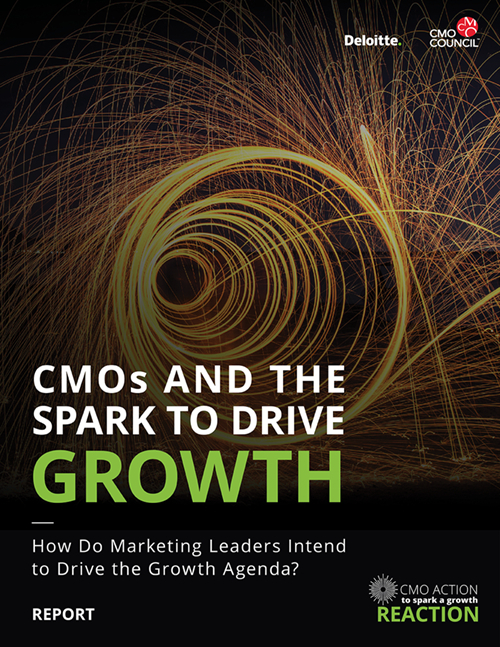
In this new 2018 survey of 191 marketing leaders, we find that CMOs are increasingly activating on growth-driving activities. They are beginning to move past the traditional role of brand storytellers to embrace the benefits of strategy leadership to ... More
Lyft is the fastest growing rideshare company in the U.S. and is available to 95 percent of the US population and Toronto, Canada. Samantha Goldman reports to the chief business officer as part of the Enterprise team and is closely connected to the overall Marketing organization at Lyft. Her team is More

The Hershey Company is a global confectionery leader known for its chocolate, sweets and other snacks. Holding more than 80 brands globally that drive more than $7.5 billion in annual revenue, Hershey is focused on continuing to build its competitive advantage in North America while growing its pres More

Aetna is a diversified benefits company whose mission is to make health care easy, affordable, and personal. Aetna serves an estimated 46.7 million people with information and resources to help make better decisions about their health care. Wendy Wahl, Head of Enterprise Marketing, helped to spearhe More

Athenahealth is a provider of network-enabled services and mobile applications for medical groups and health systems. Ranking No. 9 on Forbes’ “World’s Most Innovative Growth Companies” list, the company recently went through a restructure, and Kelly Starman, Vice President of Marketing, exp More

ARIAD Pharmaceuticals Inc. is focused on the discovery, development and commercialization of precision therapies for patients with rare cancers. The company was recently acquired by Takeda Pharmaceuticals and the acquisition of ARIAD is aimed at enhancing Takeda’s global oncology portfolio and rei More

CMO of Aston Martin’s luxury sports cars, Simon Sproule, says that the company has had a turbulent history, with many years of pro t interlaced with years of loss, 2017 saw the highest unit sales in nine years, with profit growth of a quarter-billion pounds. A December acquisition of the AM Brands More

Cambrex is a life sciences company with more than 35 years of active pharmaceutical ingredient API development and manufacturing expertise in both branded and generic API markets. Matthew Moorcroft, Vice President of Global Marketing and Intelligence, says he joined Cambrex to be a part of a growing More

Century Communities is a US homebuilder of single and multi-family residences in Colorado, Washington, California, Nevada, Utah, Texas, North Carolina, Tennessee, and Georgia. Founded in 2002 and ranked 26th in Fortune magazine’s 100 Fastest Growing Companies, the company’s mission is to create More
Ellie Mae is a leading cloud-based platform for the mortgage finance industry, offering technology solutions that help enable mortgage lenders to originate loans quickly in order to help lower their overall origination costs, all while helping ensure the highest levels of compliance, quality and eff More
Equinix operates a global interconnection platform to connect businesses to their customers, employees, and partners in order to accelerate their business, IT and cloud strategies. Ravi Ravishankar, Vice President of Marketing in APAC, says that as the internet of things (IoT) and cloud expand the n More

Since its founding in 2010, TechStyle has become one of the fastest-growing eCommerce companies in history. Together, TechStyle’s four portfolio brands—JustFab, ShoeDazzle, Fabletics, and FabKids—provide more than 5 million VIP members with on-trend fashion at an exceptional value. Monica Dere More

Flipkart is India’s largest eCommerce marketplace, with a registered customer base of more than 100 million users. Shoumyan Biswas, Head of Marketing since 2013, says marketing is responsible for the end-to-end management of customer journey and what they call M3: marketing, merchandising and mone More

Founded in 1996, LendingTree offers a fast, online way to comparison shop for loans by providing a marketplace where consumers can submit one online loan request and receive real offers from multiple lenders. Joshua Francia, Vice President of Marketing at LendingTree, describes the company’s growt More